

About us
Our commmunity
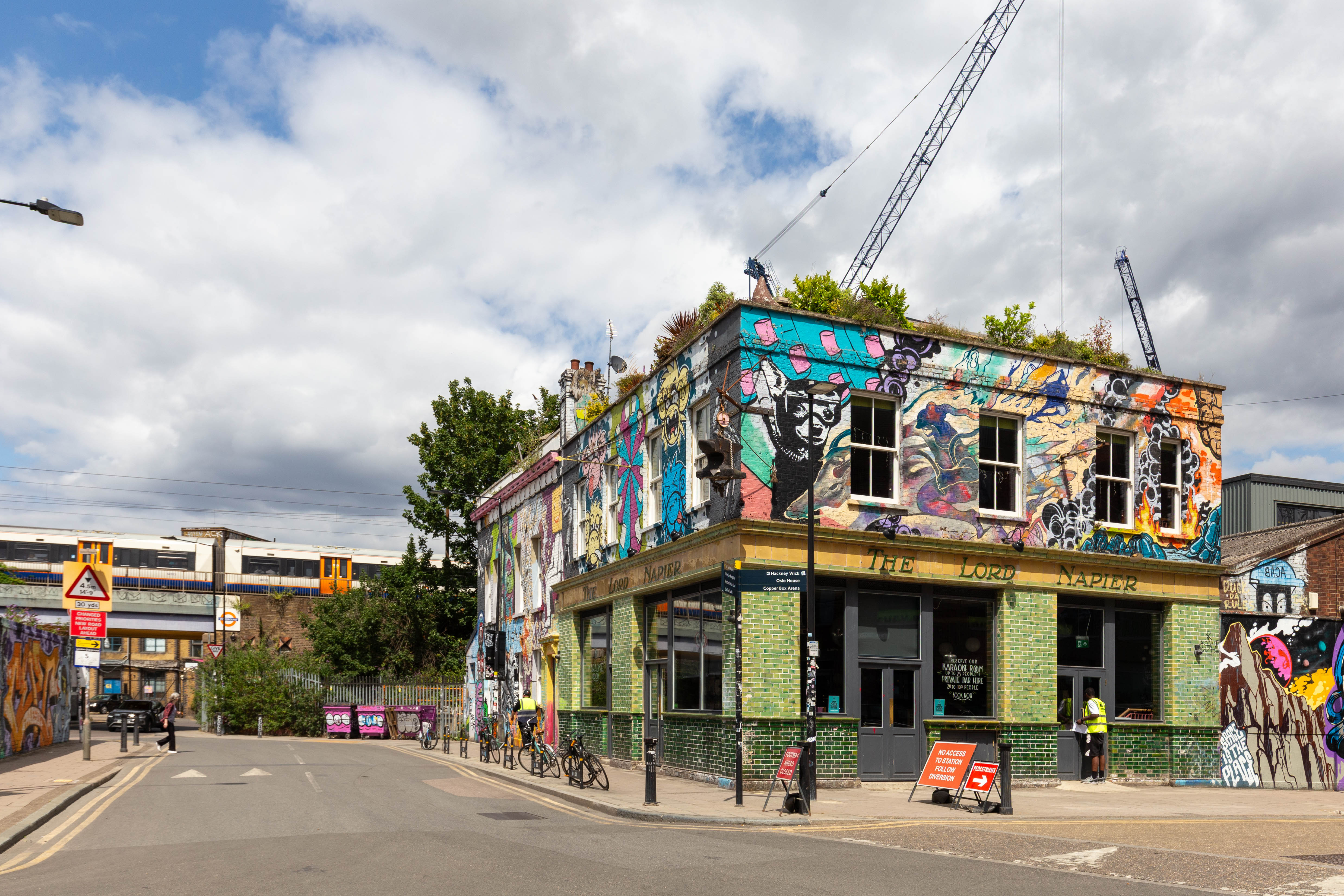
Hackney sits in that part of London where energy feels constant but never chaotic in the same way twice. It changes block by block, street by street, sometimes even hour by hour. What ties it together is not uniformity, but momentum, a sense that life here is always in motion, shaped as much by its people as by its past.
This is a borough that has never stood still long enough to be defined by a single version of itself. Industrial roots remain visible in the bones of old warehouses and canal side infrastructure, but they now sit alongside studios, bakeries, markets, and residential streets that feel deeply lived in. Hackney does not erase what it was, it layers itself over it.
Start with coffee, as most mornings in Hackney tend to.
Around Broadway Market, the day begins early. The market itself is still quiet, shutters half raised, traders setting out crates, the smell of baked goods and coffee drifting into the street. It is here you find climpses of Hackney’s rhythm at its most balanced. Coffee is often taken at Climpson & Sons, where roasting is treated with quiet seriousness and the space feels like an anchor point for the neighbourhood rather than a destination in itself. There is a steady flow of regulars, cyclists pausing briefly before continuing on, locals moving through without urgency.
A short walk away, Pophams Bakery brings a more precise kind of indulgence. Laminated pastries, considered interiors, and a kind of restrained confidence that feels very Hackney in its own way, design led but never detached. It is the sort of place where people linger slightly longer than intended, not because it demands attention, but because it holds it naturally.
Further east, around London Fields, the tone shifts again. Here, E5 Bakehouse continues to define a quieter corner of Hackney’s food culture. It sits slightly apart from the louder energy of Broadway Market, focused on sourdough, grain, and process. It feels almost agricultural in its discipline, a reminder that beneath Hackney’s surface energy there is still a deep respect for craft.
London Fields itself acts as a kind of release valve for the borough. On warm days it fills early, swimmers at the Lido moving between lanes, groups gathered loosely on the grass, the rhythm of the neighbourhood slowing just enough to notice. It is one of Hackney’s most democratic spaces, used in equal measure by families, runners, and those simply passing through.
Beyond the green space, Hackney Wick carries a different atmosphere entirely. This is where the borough’s industrial past is most visible, but also where its creative present is most concentrated. Former warehouses now house studios, breweries, and event spaces, with the canals running quietly through it all. Crate Brewery sits directly on the water, where people gather on long benches, conversations stretching into the evening without much need for structure. It feels informal, but intentional in its own way.
Nearby, Hackney Wick’s independent studios and street art create a sense of constant visual change. Walls are never entirely fixed, they evolve with each season, each event, each passing idea. It is a part of Hackney that resists permanence, but thrives on repetition.
Move north and the tempo softens again.
Stoke Newington feels almost like a different borough altogether, though still unmistakably Hackney. Church Street is its centre of gravity, lined with independent shops, bakeries, and cafés that feel rooted in daily life rather than passing trends. Abney Park nearby adds another layer entirely, a quiet, atmospheric green space where time feels slightly suspended. It is less a park than a place of pause.
De Beauvoir Town brings a different kind of order. Georgian terraces, tree lined squares, and a calm that feels carefully preserved rather than curated. There is a sense here of Hackney stepping back slightly, allowing space for stillness without losing connection to the rest of the borough.
Dalston, by contrast, holds its energy closer to the surface. Music venues, late night spaces, and a dense mix of cultures and influences give it a pace that rarely slows. Yet even here, the edges soften with time. Independent cafés sit beneath railway arches, new spaces emerge beside long standing ones, and the neighbourhood continues to redefine itself without losing coherence.
What makes Hackney distinctive is not any single destination, but the proximity of contrasts. Quiet streets sit moments away from high energy markets. Industrial canals lead directly into residential calm. Creative spaces exist alongside long established community institutions. It is this layering that gives the borough its depth.
Transport connections reinforce that sense of openness. Overground lines thread through Hackney Central, Dalston Junction, and Homerton, linking the borough seamlessly to the City and Canary Wharf, yet always returning you to something more residential in tone. It remains connected, but never absorbed.
At its core, Hackney is not defined by transformation alone, but by continuity within change. It has evolved without becoming static, grown without losing texture, and modernised without smoothing its edges. The result is a place that feels consistently alive, not because it is always new, but because it is always itself in motion.
For those who live here, that rhythm becomes familiar. For those arriving for the first time, it is often the density of life, rather than any single landmark, that leaves the strongest impression.
Hackney does not settle into a single identity. It keeps moving just enough to remain interesting.
.jpg)